
If a barrier is going to fail an inspection, the non-climbable zone is the most likely reason. The fence itself is usually fine. What sits beside it is the problem.
How the zone is measured
On the outside of a barrier that is at least 1200mm high, the non-climbable zone is an arc of 900mm struck from the top of the barrier, sweeping down and out. Anything inside that arc that a child could use as a handhold or a foothold defeats the barrier.
It is measured as an arc, not a square. That matters more than it sounds. An object 800mm out from the fence and 400mm tall may be outside a naive box measurement but well inside the arc. This is why a tape measure held horizontally along the ground gives people false confidence.
There is a second zone on the pool side: a 300mm clearance from climbable features inside the barrier. And a barrier must also be clear on the outside for 500mm at the base, with a ground clearance no greater than 100mm.
What counts as a handhold or foothold
The test is functional, not aesthetic. If a small child could get a foot or a hand onto it and use it to gain height, it counts. In Canberra backyards, the repeat offenders are:
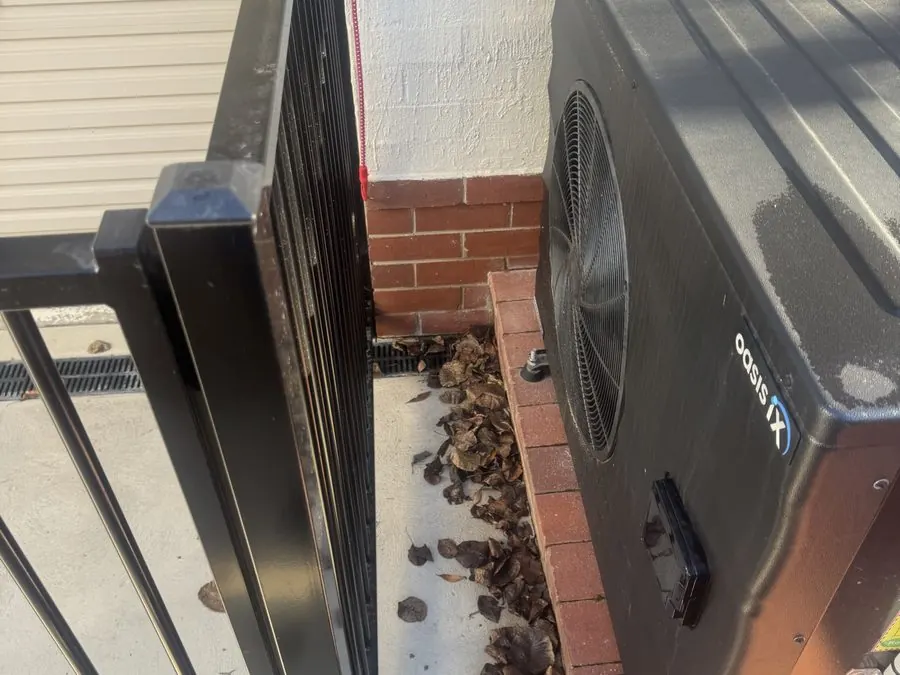
- Pool equipment. Pump housings, filter boxes and heater cabinets almost always sit against the fence, because that is where the plumbing is.
- Planters and pots. Especially the large glazed ones, and especially raised garden bed edging running parallel to the barrier.
- Firewood, pavers and building materials. Anything stacked, even temporarily. A woodpile is a staircase.
- Bins and storage boxes. Wheelie bins are mobile, which is not a defence — if that is where they live, that is where they will be.
- Trampolines and play equipment. Obvious once pointed out, and surprisingly common.
- Retaining walls and rockeries. A 400mm garden wall 600mm from the fence effectively shortens the barrier by 400mm.
- Trees and dense shrubs. Branch structure close to the barrier can absolutely be climbable, and this is the judgement call that generates the most discussion on site.
- Air-conditioning units and hot water systems. Fixed, and therefore expensive to move — worth identifying before you build a fence, not after.
Horizontal members: the other climbing aid
Where a barrier that is not a boundary fence is less than 1800mm high, horizontal members on the outside face are restricted, because they are ladders. If the gaps between vertical members are 10mm or less, the rules relax, a fence a child cannot get toes into is a different proposition. This is the reason so many older tubular fences fail: a mid-rail on the wrong side, at the wrong height.
Boundary fences work differently. A boundary fence used as part of the barrier must be at least 1800mm high, and the zone requirements applying to it differ from those for an internal barrier — including where the two intersect, which is a detail that catches a lot of otherwise careful owners.
The good news
Non-climbable zone failures are usually the cheapest kind to fix, because the answer is often to move something. A pot goes elsewhere. The woodpile shifts three metres. The pump gets a low screen instead of a cabinet. We have inspected barriers that went from six non-compliances to zero in an afternoon with no contractor involved.
The expensive version is when a fixed structure, a retaining wall, a paved terrace, a shed — sits inside the zone. Those are the ones worth knowing about early, which is the argument for booking the inspection well ahead of a deadline rather than the week before.
Need this sorted for a specific property?
Compliance status certificate $479 all inclusive, including the ACT Government lodgement fee. Disclosure statements $400. Free advice on the phone if you’re not sure which you need.
Book an Inspection 0456 676 683