
Everything else in a barrier is static. The gate has hinges, springs and a latch, all of which age. It is the single component most likely to have been compliant once and not be compliant now.
What we test on site
1. Which way it swings
A pool barrier gate must open away from the pool area. A gate that swings inward can be pushed open by a child leaning on it, and a self-closer working against gravity or a spring is a weaker safeguard. Reversing a gate is generally straightforward, but it does mean new hardware.
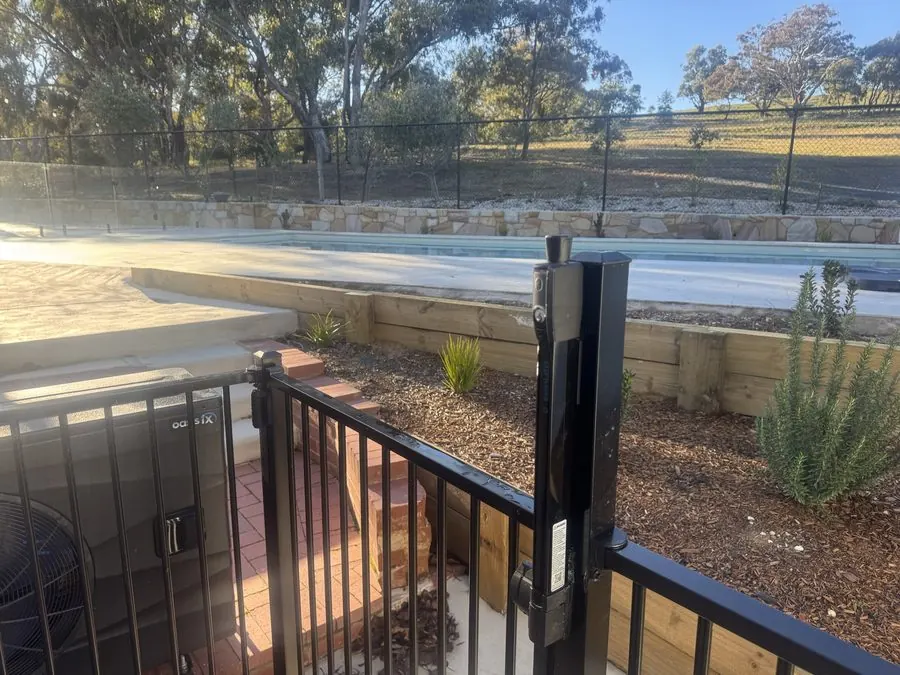
2. Self-closing from any position
We open the gate to a few degrees, to halfway, and to fully open, and let it go each time. It has to close and latch from all of them. The classic failure is a gate that closes from wide open but stalls when released from 100mm ajar, which is exactly how children leave gates.
3. Self-latching, and staying latched
The latch must engage on closing without anyone touching it. Then we test it the way a child would: we lift the gate, and we push down on it. If the latch releases under either, it fails. Worn hinges and dropped gates are the usual cause, and a gate that has sagged 5mm will often unlatch when lifted.
4. Latch release height and position
The release must be positioned so a small child cannot reach it, which means height and location, and also whether it can be reached through the barrier from outside. A latch at the right height but on a gate with 90mm gaps beside it is still reachable through the fence, which is where shielding comes in.
5. Shielding on openings over 10mm
Where the barrier or gate has vertical openings greater than 10mm near the latch, shielding is required so the release can’t be reached from the outside. Retro-fitted shields are common and often the cheapest fix on the list.
6. Hinges as footholds
Protruding hinges are climbable. So are hinge bolts and brackets that stand off the face of the gate. We check both hinge geometry and the gaps around them.
7. Gate geometry
The same rules that apply to the barrier apply to the gate: minimum height, ground clearance no greater than 100mm, and vertical member spacing within limits. Gates get bumped, and a gate that has been knocked out of square can develop a wedge-shaped gap at the latch stile.
8. Doors and windows into the pool area
If a door from the house or an outbuilding opens into the pool area, it comes under scrutiny too — self-closing and self-latching operation, latch release height, and the non-climbable zone on the outside. Windows matter as well: where the sill of the lowest openable panel sits below 1800mm above the ground, the opening has to be restricted. And a pet door into the pool area is an unrestricted opening.
The five-second test you can do yourself. Open the gate 100mm and let go. If it closes and latches, open it fully and let go. If that latches too, lift the gate hard and try to open it. Most gates that pass all three will pass an inspection on the gate items.
What fixes cost
Gate hardware is the cheap end of pool compliance. A replacement self-closing hinge set or a magnetic latch is a small parts cost plus an hour of labour, and it is work a competent owner can often do. The expensive scenario is a gate that has to be rehung or rebuilt because the posts have moved, which is worth discovering with two years up your sleeve rather than two weeks before settlement.
Need this sorted for a specific property?
Compliance status certificate $479 all inclusive, including the ACT Government lodgement fee. Disclosure statements $400. Free advice on the phone if you’re not sure which you need.
Book an Inspection 0456 676 683